
Why Do Similar Custom Iced Out Pendants Get Different Quotations?
Custom iced out pendant quotations vary based on materials, gemstones, design complexity, and production requirements. MISSJEWELER provides accurate quotations through professional CAD planning and manufacturing expertise.
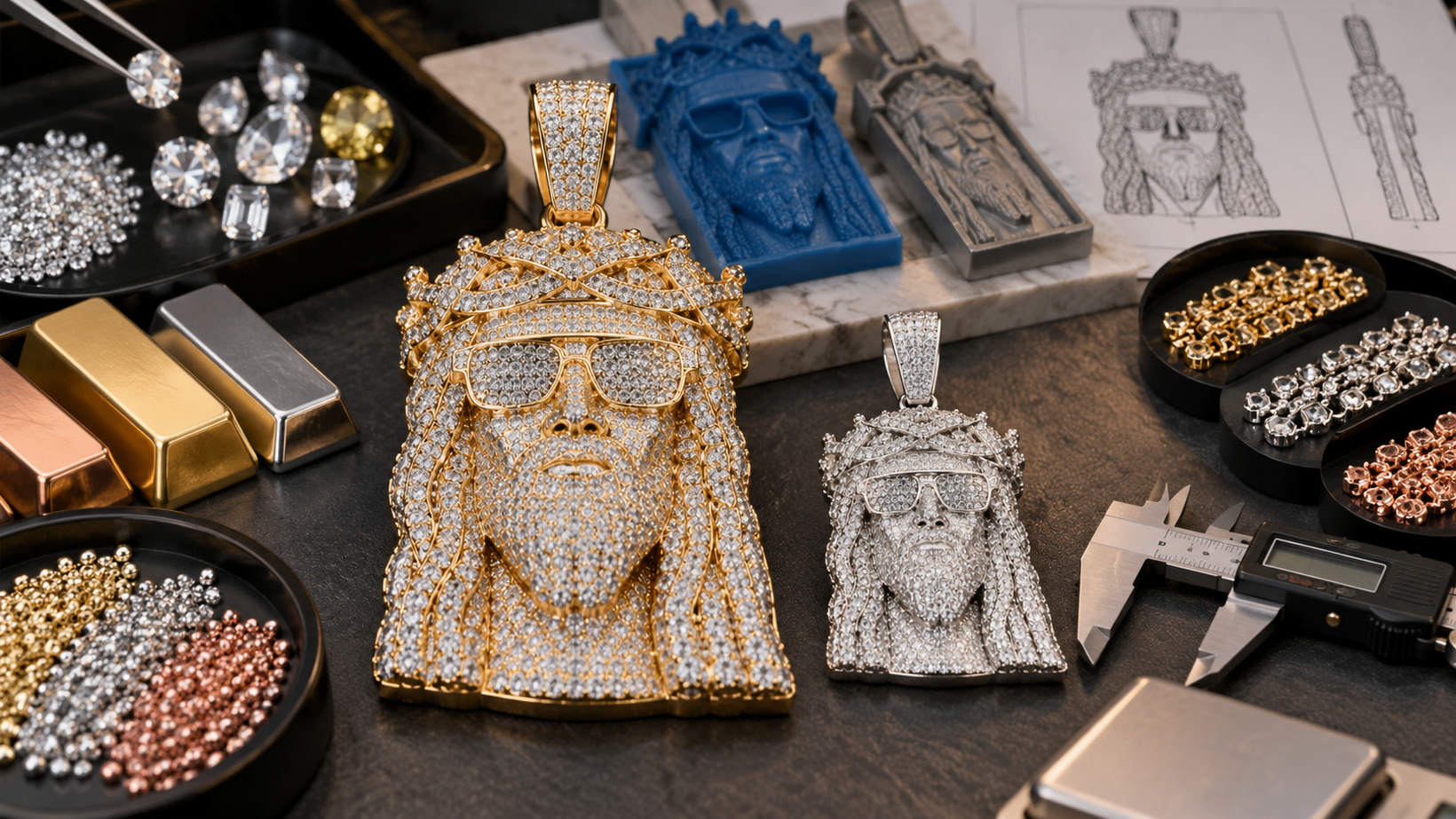
A jewelry brand sends the same custom iced out pendant design to several manufacturers but receives noticeably different quotations. Although the finished pendants may look nearly identical, their metal materials, internal structures, gemstone specifications, and manufacturing requirements can vary significantly. Differences in development costs, quality control, order quantities, and included services can also affect the final price. Understanding these factors helps jewelry brands compare factory quotations fairly, control purchasing costs, and choose manufacturing solutions that fit their product requirements.
Quick Answer: Why Do Similar Custom Iced Out Pendants Receive Different Quotations?Similar custom iced out pendants receive different quotations because manufacturers may use different base metals, metal weights, internal structures, gemstone types, stone-setting methods, plating specifications, and quality control requirements. CAD development, tooling fees, minimum order quantities, and commercial terms also influence pricing.For B2B jewelry buyers, the most reliable way to compare quotations is to evaluate identical manufacturing specifications and total project costs rather than product appearance or unit price alone.
Why Similar Pendant Designs Receive Different Factory Quotes
Identical Appearance Does Not Mean Identical Construction
Two custom iced out pendants may feature the same logo, dimensions, and gemstone-covered appearance while using different internal structures.One manufacturer may design a thicker, solid metal backing, while another uses a lighter or hollow construction. These differences affect metal consumption, estimated weight, manufacturing requirements, and overall production costs.For oversized iced out pendants, backing thickness, bail construction, attachment points, and weight distribution also influence wearing comfort and structural performance.A similar front appearance does not necessarily mean the products have equivalent manufacturing specifications.
Different Manufacturing Requirements Affect Production Costs
Manufacturing costs depend on more than the visible design.Gemstone quantity, setting complexity, metal structure, polishing requirements, plating specifications, and inspection procedures can all affect production time and material consumption.A pendant requiring thousands of small stone-setting operations may involve different labor requirements from a design using fewer, larger stones, even when both achieve a similar iced out appearance.However, a higher quotation does not automatically guarantee better workmanship. Buyers should confirm whether each manufacturer can meet the same agreed technical requirements.
Factory Operating Costs and Pricing Policies Vary
Even when two manufacturers receive identical specifications, their quotations may still differ.Material purchasing costs, production efficiency, labor expenses, equipment, factory overhead, and commercial pricing policies can influence the final quotation.Some factories include certain development expenses in their unit prices, while others charge separately for CAD development, tooling, or samples.The important question for buyers is what each quotation includes and whether the proposed manufacturing solution meets their requirements.
What Is Included in a Custom Pendant Quotation?
Unit Manufacturing Costs
The unit manufacturing price generally reflects the agreed materials and production processes required for each finished pendant.Depending on the quotation, these costs may include base metal, gemstones, casting, stone setting, polishing, plating, assembly, and standard quality inspection.Buyers should confirm the exact manufacturing specifications behind the unit price rather than assuming every supplier uses the same pricing structure.
CAD, Tooling, and Sample Development Fees
Custom iced out pendants may require CAD design, engineering adjustments, molds, and sample development before bulk production.Some factories charge these expenses separately, while others include certain development costs in the project quotation.For jewelry brands planning repeat orders, it is important to ask whether approved designs and suitable tooling can be reused, under what conditions, and whether additional fees apply.
Packaging, Inspection, and Delivery Charges
Custom packaging, specialized testing, third-party inspection, shipping, and other requested services may add to the total project cost.The following table shows what buyers should check.
| Quotation Item | What Buyers Should Confirm |
|---|---|
| Unit Price | Metal, gemstones, manufacturing processes, and finishing |
| CAD Development | Design preparation, revisions, and included services |
| Mold Fee | Tooling costs and future reuse conditions |
| Sample Fee | Sample production, adjustments, and shipping |
| Quality Control | Inspection scope and acceptance standards |
| Packaging | Standard packaging or custom branded packaging |
| MOQ | Minimum quantity and quantity-based pricing |
| Delivery | Lead time, shipping arrangements, and trade terms |
A lower unit price does not necessarily mean a lower total project cost. Buyers should compare the complete quotation, including development expenses, required services, and delivery terms.
Seven Factors That Change Iced Out Pendant Pricing
- Base Metal Type, Weight, and Internal Structure
Base metal selection is one of the most important factors influencing custom iced out pendant manufacturing costs.Common materials include brass, 925 sterling silver, and solid gold. Stainless steel may also be suitable for certain designs, depending on the manufacturing process and stone-setting requirements.These materials have substantially different purchasing costs and manufacturing characteristics.Brass is commonly considered for cost-conscious fashion jewelry, while 925 sterling silver and solid gold involve different precious-metal costs.For sterling silver and solid gold pendants, metal weight is particularly important when calculating material costs.However, material selection is only part of the pricing equation.Two pendants with identical external dimensions can have different weights because of their thickness, backing structures, and internal construction.For example:
- Solid Construction: Generally requires more metal than a comparable hollow design and may have different structural and manufacturing characteristics.
- Hollow Construction: Can reduce metal consumption in suitable designs but requires careful consideration of structural support and production feasibility.
- Thicker Backing: May increase metal weight while providing additional support where the design requires it.
- Lighter Construction: Can reduce weight and potentially material cost, provided the design maintains suitable structural support.
The cost impact of these choices depends on the metal and manufacturing process. A hollow design is not automatically the least expensive manufacturing option.For oversized pendants, reducing weight must not compromise gemstone support, bail strength, attachment points, or wearing balance.Buyer Takeaway: Confirm the base metal, estimated weight, thickness, internal structure, and bail requirements before comparing custom pendant quotations.
- Gemstone Type, Size, and Total Stone Count
Gemstone selection can create substantial cost differences between visually similar iced out pendants.Custom hip hop jewelry commonly uses cubic zirconia (CZ) or moissanite.Under comparable purchasing conditions, moissanite generally has a higher material cost than CZ, although actual prices depend on gemstone specifications, quality, and quantity.Gemstone type is not the only cost factor. Stone size, total stone count, layout complexity, and setting labor also affect the final manufacturing quotation.Two pendants with the same dimensions may use different gemstone arrangements.One design may contain many small stones placed close together, while another uses fewer, larger stones to create a similar visual effect.Smaller stones are not necessarily cheaper to manufacture into a finished pendant because a dense layout may require more individual setting operations.
| Pricing Factor | CZ Pendant | Moissanite Pendant |
|---|---|---|
| Stone Material Cost | Generally lower | Generally higher |
| Stone Size | Customizable | Customizable |
| Total Stone Count | Depends on design | Depends on design |
| Setting Labor | Depends on layout complexity | Depends on layout complexity |
| Total Manufacturing Cost | Depends on complete specifications | Depends on complete specifications |
At MISSJEWELER, gemstone sizes and quantities are considered during CAD design so the required materials and production work can be evaluated before manufacturing.For additional gemstone information, buyers can refer to the Gemological Institute of America (GIA) and the International Gemological Institute (IGI).Buyer Takeaway: Ask manufacturers to specify gemstone types, sizes, approximate quantities, and quality requirements instead of relying only on descriptions such as "fully iced out."
- Stone Setting Methods and Prong Construction
Stone setting is an important labor component in custom iced out pendant manufacturing.Prong, pavé, micro-pavé, and bezel settings involve different preparation and manufacturing requirements.Complex logo pendants may feature curved surfaces, raised lettering, closely spaced gemstones, and multiple setting levels.These design characteristics affect gemstone placement, prong construction, surrounding metal support, and setting labor.Stone-setting feasibility should be considered during product development rather than only after manufacturing begins.At MISSJEWELER, prong positions, gemstone placement, and practical manufacturing requirements are considered during the design stage.This approach helps reduce unnecessary production adjustments and provides a clearer foundation for later manufacturing.Poorly designed prongs, insufficient metal support, or unsuitable stone seats can still create production problems and may require correction. Such risks should be evaluated during development.Buyer Takeaway: Compare stone-setting layouts, prong requirements, metal support, and manufacturing feasibility—not simply gemstone coverage or the lowest quoted price.
- CAD Design Complexity and Mold Development
CAD design plays an important role in translating a custom pendant concept into practical manufacturing specifications.A simple flat logo pendant may require less development work than an oversized three-dimensional pendant with raised letters, curved surfaces, recessed details, and multiple gemstone-setting levels.Greater design complexity can increase CAD engineering, structural evaluation, tooling, and sample development requirements.At MISSJEWELER, custom pendant quotations begin with communication about the buyer's preferred materials and target budget.During CAD development, important manufacturing information is established and reviewed, including:
- Gemstone sizes
- Total gemstone quantity
- Estimated metal weight
- Pendant dimensions and thickness
- Internal structure and backing requirements
- Prong positions and gemstone placement
These specifications provide a basis for refining the quotation and developing samples.Rather than waiting until production begins to determine fundamental design requirements, the factory considers these details during development.For buyers, this helps clarify material consumption, technical requirements, and expected manufacturing costs before bulk production.New molds, specialized tooling, and additional design revisions may increase initial development expenses.Because some development expenses are fixed, they can have a greater impact on smaller initial orders.Buyer Takeaway: Discuss your preferred materials and target budget early, and confirm which CAD, tooling, and sample development services are included in the quotation.
- Surface Polishing, Plating, and Finishing Standards
Two iced out pendants may have a similar gold or silver appearance while using different finishing specifications.Surface preparation, polishing requirements, plating materials, coating thickness, color consistency, and relevant inspection procedures can influence manufacturing costs.A quotation described only as "gold plated" does not provide enough technical detail for an accurate comparison.Depending on the project, buyers may need to confirm plating materials, target coating thickness, plating color, surface finish, and applicable testing requirements.Complex iced out pendants may also require additional polishing attention around small stone-setting areas, narrow edges, and raised designs.For growing jewelry brands, finishing consistency is particularly important when planning repeat orders.Manufacturers and buyers should agree on appropriate color references and finishing specifications to help maintain consistent product appearance.The FTC Jewelry Guides provide guidance on jewelry product descriptions and representations for the United States market.Buyer Takeaway: Compare specific plating and finishing requirements rather than assuming similarly colored pendants use equivalent coating systems.
- Quality Control and Sample-to-Bulk Consistency
Quality control can influence custom pendant manufacturing costs because inspection requires personnel, equipment, time, and appropriate acceptance standards.For custom iced out pendants, inspection should cover more than general appearance.The purpose of quality control is to identify relevant manufacturing defects and confirm whether products meet approved specifications.Important inspection areas include:
- Material Inspection: Confirm the agreed base metal and relevant specifications.
- Dimensional Inspection: Check pendant size, thickness, and structural details.
- Stone Security Inspection: Examine stone placement, prong condition, and visible looseness.
- Surface Inspection: Review polishing quality, plating appearance, and finishing consistency.
- Structural Inspection: Check backing, bail construction, and attachment points.
- Sample Comparison: Compare bulk production against approved samples and documented requirements.
Depending on the design, stone-setting inspection may include magnified examination, gentle stability checks, and other suitable methods.Manufacturers may provide different inspection scopes within their quotations.However, additional inspection steps or higher prices do not automatically guarantee better results. The suitability and consistent application of agreed inspection requirements are more important.No practical manufacturing process can guarantee that gemstones will never become loose during their service life. Appropriate design planning, manufacturing controls, and inspection methods can nevertheless help reduce avoidable defects.Buyer Takeaway: Evaluate agreed inspection requirements, approved sample standards, and repeat-production consistency alongside the manufacturing quotation.
- MOQ, Production Volume, and Order Requirements
Minimum order quantity (MOQ) can affect custom pendant quotations because development and production preparation involve expenses that may not change proportionally with order size.These may include CAD development, mold preparation, production setup, and sample development.When fixed costs are distributed across a smaller number of pendants, the effective cost per piece may be higher.For example, producing 20 custom pendants may require some of the same preparation work as producing 200 pieces.Larger production quantities can distribute certain fixed expenses across more units.However, metal consumption, gemstone costs, stone-setting labor, and finishing processes still contribute to the variable cost of each piece.Urgent schedules, custom packaging, additional testing, and special project requirements may also affect pricing.Buyer Takeaway: Request quotations at relevant quantity levels, confirm separate development charges, and ask how future repeat-order pricing will be calculated.
A Side-by-Side Comparison of Three Factory Quotations
Example: Three Manufacturers Quoting the Same Pendant
Consider a jewelry brand requesting quotations for the same custom iced out logo pendant from three manufacturers.For this illustration, assume each factory receives identical CAD specifications, metal requirements, gemstone information, plating standards, quality acceptance criteria, and an order quantity of 100 pieces.The figures below are hypothetical amounts used only to demonstrate quotation calculations. They are not actual supplier quotations, MISSJEWELER prices, or representative market prices.
| Quotation Item | Factory A | Factory B | Factory C |
|---|---|---|---|
| Unit Price | $38 | $41 | $43 |
| Quantity | 100 | 100 | 100 |
| Production Subtotal | $3,800 | $4,100 | $4,300 |
| Tooling Fee | $420 | $250 | $150 |
| Sample Fee | $180 | $180 | $120 |
| Shipping Charge | $200 | $200 | Included |
| Total Quoted Cost | $4,600 | $4,730 | $4,570 |
Illustrative assumptions: All factories quote equivalent product specifications, one separately charged development sample, comparable delivery services, and no additional quoted charges. Duties, taxes, and any unspecified expenses are excluded.
Why the Lowest Unit Price May Not Be the Lowest Total
Factory A offers the lowest unit price at $38, but its additional tooling, sample, and shipping charges increase the total quoted cost.Factory B has a higher unit price and a different development cost structure.Factory C has the highest unit price but the lowest total quoted project cost in this hypothetical comparison because of its lower additional charges and included shipping.This example demonstrates why buyers should compare complete project costs rather than unit prices alone.However, the comparison is valid only when the technical specifications and commercial terms are equivalent.
What Buyers Should Compare Beyond Price
Similar totals do not necessarily indicate equivalent manufacturing value.Buyers should verify that each supplier is quoting the same materials, gemstone requirements, construction details, finishing standards, quality expectations, and sample approval conditions.Shipping terms, destinations, taxes, and duties should also be compared consistently.A suitable quotation balances defined product requirements, total purchasing cost, and the manufacturer's ability to deliver the agreed specifications.
How Can Brands Reduce Custom Iced Out Pendant Costs?
Custom jewelry brands often need to balance design appearance, manufacturing quality, and target selling prices.Cost optimization should focus on adjusting suitable product specifications rather than simply requesting a lower price for unchanged requirements.
Choose Materials Based on Product Positioning
Metal selection has a direct influence on manufacturing cost.Brass, 925 sterling silver, and solid gold serve different product positioning and budget requirements.Selecting a material that matches the brand's target market can help establish a more realistic manufacturing budget.However, buyers should also consider customer expectations, product descriptions, durability requirements, and relevant market regulations.
Optimize Gemstone Sizes and Layouts
A fully iced out appearance can sometimes be achieved through different gemstone arrangements.Changing stone sizes, quantities, or layouts may affect both gemstone consumption and setting labor.For brands with flexible designs, comparing CZ and moissanite options can also help evaluate different product positioning and manufacturing budgets.Any adjustment should be reviewed for its effect on appearance, stone security, and production feasibility.
Review Thickness and Internal Construction
Pendant thickness, metal weight, and internal structure can influence material consumption.For precious-metal pendants, particularly 925 sterling silver and solid gold, weight is an important cost consideration.Lighter or hollow structures may be suitable for some designs, but they should not be selected without evaluating backing support, bail construction, and gemstone-setting requirements.Reducing metal consumption is useful only when the resulting construction remains suitable for the intended product.
Plan Quantities and Reusable Development Work
Buyers should request prices for realistic order quantities and clarify whether tooling and approved design files can be reused.For repeat orders, previously completed development work may reduce certain additional setup requirements, depending on the factory's policies and project conditions.Cost optimization should protect essential structural, manufacturing, and quality requirements rather than reduce specifications indiscriminately.
How Buyers Can Compare Factory Quotes Fairly
Compare Identical Technical Specifications
Before evaluating price differences, buyers should provide each manufacturer with the same confirmed technical information.This includes CAD drawings or design references, dimensions, metal type, estimated weight, gemstone specifications, setting requirements, plating standards, and order quantity.Different technical assumptions make direct quotation comparisons unreliable.For example, a lighter hollow pendant should not be treated as equivalent to a heavier solid pendant simply because the front appearance looks similar.
Evaluate Whether a Higher Quote Is Justified
A higher quotation may be reasonable when it includes additional requirements, services, or clearly defined manufacturing specifications that another supplier excludes.However, buyers should request evidence rather than assuming a higher price means higher quality.
| Evaluation Area | What Buyers Should Verify |
|---|---|
| Product Specifications | Metal, weight, thickness, gemstone and structural requirements |
| Sample Development | Sample scope, approval requirements, and revision conditions |
| Tooling | Mold charges, ownership terms, and reuse arrangements |
| Quality Control | Inspection methods, scope, and acceptance requirements |
| Repeat Production | Approved sample references and production documentation |
| Commercial Terms | Total cost, payment terms, and additional fees |
| Delivery | Production lead time, shipping, and responsibilities |
A manufacturer charging more should be able to explain the relevant differences in specifications or included services.Choose a higher quotation only when the additional cost provides identifiable purchasing value or supports requirements that matter to the project.
Use a Custom Pendant Quotation Checklist
Before selecting a supplier, confirm the following information.
表格结构较复杂,已保留为可读文本。发布前请在 Preview 中检查并按需重建表格。
Requirement | Details to Verify
Pendant Design | CAD version, dimensions, thickness, and structure
Metal | Type, purity where relevant, and estimated weight
Gemstones | Type, sizes, quantity, and quality requirements
Stone Setting | Method, layout, and prong requirements
Plating | Material, color, thickness, and finish
Tooling | Mold fees and reuse conditions
Sampling | Sample cost, approval process, and revisions
MOQ | Minimum quantity and relevant pricing tiers
Quality Control | Inspection scope and acceptance criteria
Delivery | Lead time, packaging, shipping, and trade termsA reliable quotation comparison begins with consistent technical specifications and transparent commercial terms.
When a Lower Quote Can Increase Total Costs
Stone Security Problems and Rework
Insufficient prong support, unsuitable stone seats, or inaccurate gemstone placement can contribute to stone-security problems.If finished products require repairs, gemstone replacement, or additional inspection, the total project cost may increase.Considering stone-setting requirements during design and production preparation can help reduce avoidable manufacturing problems.However, a lower quotation does not automatically indicate poor stone-setting quality.
Inconsistent Plating and Finishing
Different surface preparation methods, plating specifications, or inspection requirements may result in different finishing outcomes.For jewelry brands, visible variations between production batches can affect product presentation and customer satisfaction.Clear finishing specifications and approved references help reduce uncertainty when placing repeat orders.
Sample-to-Bulk Differences
An approved sample establishes an important reference, but consistency during bulk manufacturing also depends on documented production requirements.Pendant dimensions, metal specifications, stone placement, structural details, and finishing standards should be available for production and inspection.Buyers should consider possible rework, after-sales costs, and repeat-order consistency when evaluating the total purchasing value of a quotation.
What to Send Manufacturers for an Accurate Quote
Prepare Design and Manufacturing Information
A clear quotation request helps manufacturers understand the intended product and evaluate its manufacturing requirements.Buyers can provide a CAD drawing, logo artwork, product reference image, or other suitable design information.Useful specifications include:
- Pendant dimensions and preferred thickness
- Base metal and preferred material specifications
- Estimated weight or target weight, if available
- Gemstone type, size, and desired coverage
- Stone-setting preferences
- Plating color and finishing requirements
- Bail construction, backing details, and engraving
A complete CAD design is not always necessary for an initial discussion, but more detailed specifications can improve quotation accuracy.
Confirm Budget and Order Requirements
Manufacturers also need relevant commercial information.Buyers should communicate:
- Target budget, if available
- Expected order quantity
- Preferred materials
- Sample development requirements
- Intended sales market
- Packaging requirements
- Target production or delivery timeline
- Special quality and testing requirements
Providing a realistic budget and clear product expectations helps manufacturers evaluate suitable materials and development requirements.
Request Separate Options When Specifications Are Flexible
Some brands have not finalized every material or design detail before contacting a factory.When appropriate, they can request separate quotations for different options, such as brass with CZ or 925 sterling silver with moissanite.Each option should clearly identify its own materials, manufacturing requirements, estimated weight, gemstone specifications, and included services.These comparisons are useful for exploring product positioning and budget alternatives, but they should not be treated as identical products.
Get a Clearer Custom Iced Out Pendant Quotation
Have a custom pendant concept in mind?Share your design reference, preferred materials, target budget, and expected order quantity with MISSJEWELER. Our team can discuss relevant manufacturing requirements and help develop a quotation based on your project specifications.Request a Custom Pendant Quote
How MISSJEWELER Approaches Custom Pendant Quotations
For growing jewelry brands, a clear quotation process involves more than assigning a price to a product image.At MISSJEWELER, material selection, budget expectations, CAD specifications, and production feasibility are important considerations during custom pendant development.
Step 1: Confirm Materials and Target Budget
Custom pendant discussions begin with understanding the buyer's preferred materials and budget expectations.Brass, 925 sterling silver, and solid gold involve different material costs, while pendant thickness, weight, and internal construction can further influence pricing.Clarifying these requirements early provides a foundation for evaluating suitable manufacturing options.
Step 2: Determine Key Specifications During CAD Design
During CAD development, important manufacturing data is established and reviewed.This includes gemstone sizes, total stone count, estimated metal weight, pendant thickness, and structural details.Prong positions and gemstone placement are also considered in relation to practical production requirements.Confirming these specifications during development helps clarify material consumption and manufacturing requirements before production.
Step 3: Review Manufacturing Feasibility and Costs
Custom iced out pendants need to balance visual appearance with practical construction.For complex logos and oversized pendants, relevant considerations include backing support, stone-setting layout, bail structure, overall weight, and wearing balance.The agreed design requirements provide a basis for evaluating manufacturing costs and refining the quotation.This planning approach helps reduce the need for avoidable adjustments after production begins.
Step 4: Support Sample and Bulk Production Requirements
Once the design and relevant project requirements are confirmed, the agreed specifications provide a reference for sample development and subsequent production.For jewelry brands planning repeat orders, maintaining clear product requirements is important for consistency.At MISSJEWELER, our manufacturing approach emphasizes appearance, practical construction, stone-setting considerations, and consistency from approved designs to finished jewelry.Our goal is to help brands understand their manufacturing requirements and make informed sourcing decisions before committing to bulk production.
Conclusion: Compare Specifications Before Choosing a Supplier
Similar custom iced out pendants can receive different quotations because their metal materials, weights, internal structures, gemstone requirements, setting methods, finishing standards, development costs, and commercial terms may differ. For B2B jewelry buyers, confirming technical specifications early and comparing complete project costs provides a stronger foundation for selecting a suitable manufacturing partner.
Ready to Bring Your Custom Iced Out Pendant Design to Life?
Choosing the right custom iced out pendant manufacturer involves more than finding the lowest quotation.At MISSJEWELER, we help growing jewelry brands develop custom pendants with attention to material selection, CAD specifications, gemstone-setting structures, manufacturing feasibility, and production consistency.Whether you are developing a custom logo pendant, an oversized iced out design, or a new wholesale jewelry collection, clear specifications and early production planning can help you make better purchasing decisions.Share your design, preferred materials, target budget, and expected order quantity with our team to discuss your custom pendant manufacturing requirements.
Frequently Asked Questions
1. Why Do Similar Custom Iced Out Pendants Have Different Prices?
Similar custom iced out pendants may have different prices because of differences in metal materials, estimated weight, internal construction, gemstone specifications, manufacturing processes, and included services. Factory production efficiency and pricing policies can also vary. Buyers should compare complete manufacturing requirements rather than judging quotations by appearance alone.
2. Does Pendant Weight Affect Manufacturing Costs?
Yes. Pendant weight can significantly affect material costs, especially for precious metals such as 925 sterling silver and solid gold. Two pendants with the same external dimensions may have different weights because of their thickness and internal construction. A heavier pendant is not automatically better; structural suitability, gemstone support, and wearing comfort also matter.
3. Is Moissanite More Expensive Than CZ for Custom Pendants?
Moissanite generally costs more than CZ under comparable purchasing conditions, but the total pendant cost also depends on gemstone sizes, stone quantities, setting requirements, metal materials, and order volume. Buyers should compare complete gemstone and manufacturing specifications rather than gemstone names alone.
4. Can Manufacturers Quote Before CAD Design Is Complete?
Manufacturers may provide an initial estimate based on available design references, materials, expected dimensions, and order quantity. However, a more accurate quotation generally requires clearer manufacturing specifications. At MISSJEWELRY, CAD development helps establish gemstone sizes, stone quantities, estimated weight, pendant thickness, and structural details. Confirming these specifications helps refine the quotation before sample development and production.
5. Does a Higher Factory Quote Guarantee Better Quality?
No. A higher quotation does not automatically guarantee better manufacturing quality. Price differences may reflect materials, production methods, factory operating costs, development services, inspection requirements, or commercial policies. Buyers should evaluate measurable specifications, approved samples, relevant quality requirements, and included services before deciding whether a higher quotation offers additional value.
6. How Does MOQ Affect Custom Iced Out Pendant Pricing?
MOQ can influence unit pricing because development and setup expenses may be distributed across different production quantities. Larger orders may reduce the effective per-unit impact of certain fixed expenses, but metal, gemstones, setting labor, and finishing remain important costs. Buyers should request relevant quantity-based quotations and confirm whether tooling or development charges are separate.
Get an Accurate Quote for Your Custom Iced Out Pendant
Every custom pendant has different material, weight, stone, and production requirements. Share your design and budget with MISSJEWELER to receive a quotation based on your specific needs.